Death happens to all of us, and it reveals that life is ephemeral. It provides an opportunity to recognize the ephemeral nature of life and be inspired to make the time we have on earth more meaningful. As normal, expected, orderly, and even productive it is for human beings to die, it still can be difficult to accept. I think funerals are a way to help us deal with challenge. When we attend a funeral, we may share our reflections and witness others’ memories about how loved ones impacted the ones who remain. Often times, what is difficult or complicated to verbalize out loud to multiple audiences is often documented in print.
Announcing a person’s death often is associated with a review of their lives, usually in printed formats like funeral announcements, obituaries, and memorial service programs. Funeral announcements are usually minimalist but informative, notifying the community that an individual has died, as well as when and where they will be memorialized and buried. They typically are published in newspapers associated with their hometown(s) and/or place of death, but they also may appear in church bulletins and other community publications, online or in print.
Like funeral announcements, newspaper obituaries serve to announce someone’s death. They usually are concise, citing basic information about birth, death, and family relationships; they also can be extended summaries of a person’s life experiences and contributions to their communities. Funeral programs are very similar to announcements but typically are distributed at a meeting place where people convene to honor the person who has died. They can be as simple as a folded paper printed in black and white or an ornately designed pamphlet with poems, family messages, and colorful photographs.
In terms of how much information is printed and published about the deceased individual, a number of factors come into play, including perhaps cost (e.g., charges for excess word/page count, black and white v. color printing), time constraints (i.e., how much time do they have to gather and prepare a product?), educational resources (e.g., who will write the life summary, and how well will they convey important information?). Another factor may involve how well the individual was known by the people supplying the information for the document. The more intimate and positive the relationship, the more information and memories that might be shared. Another important factor to consider is generational effects. I’ve noticed that older (i.e., early 20th century) obituaries and funeral programs are briefer and perhaps narrower in scope than those of modern times.
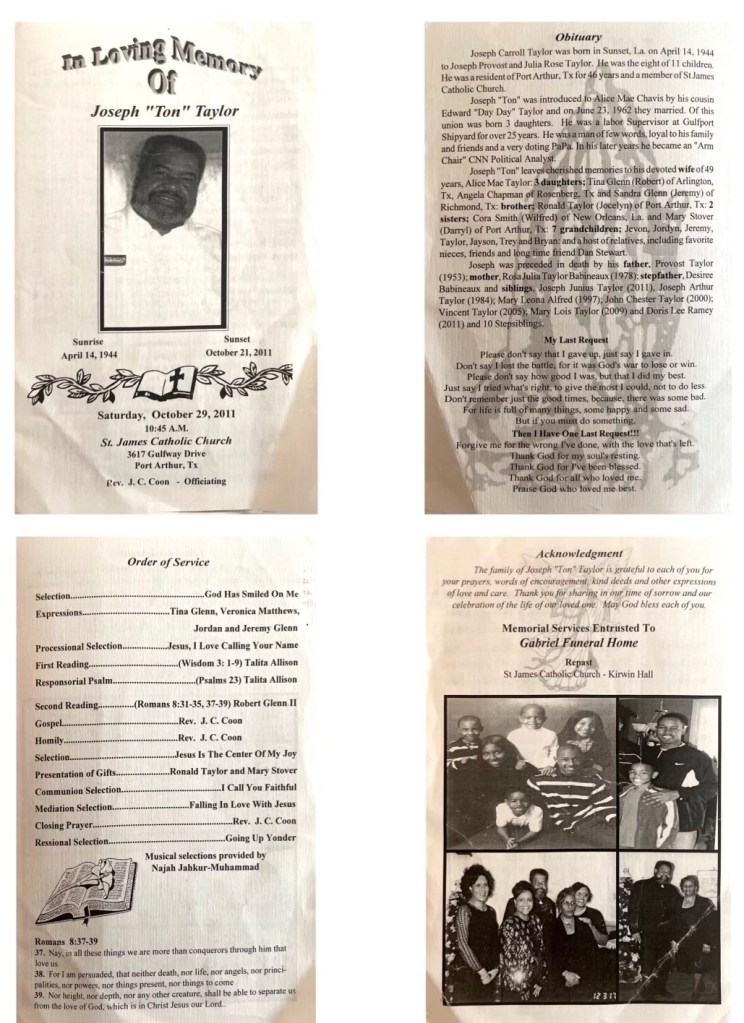
The front cover of funeral programs often have headings such as “Homegoing Celebration,” “In Loving Memory of”, and “Obsequies”. They feature prominently, on the front page, the deceased’s name, image, dates of birth and death as well as the location, date, and officiant of the memorial service. On the interior pages, we usually learn about the person’s parentage, siblings, education and work activities, and religious affiliations. There also may be photographs of the decedent and relatives; poems of reassurance and comfort about the decedent’s afterlife, usually from the decedent’s point of view; and messages from various close relatives to the deceased. We also learn about the person’s surviving relatives and those who preceded them in death. If the memorial was religious in nature, we might read of the “Order of Service” listing the sequence of presentations and presenters’ names; scriptural references may be interspersed throughout the program.
This is one of my favorite obituaries, so far, because it gives a summary of Joseph “Ton” Taylor’s origins, work history, and personality. In addition, it lists, not only his immediate family members, but also his predecessors and the years of their deaths, which can be used to conduct more extensive family research. For example, I might want to secure their death certificates to determine potential patterns in medical history; to find out about the parentage of Taylor’s father, Provost; or to learn more about Taylor’s mother. Notice that her name is cited as Rosa Julia Taylor Babineaux and Taylor has “to step siblings”; based on reading this funeral program, I might want to investigate what Rosa Julia’s maiden name is and who she remarried after her husband died.
I don’t love when people who I love die, but I do love collecting funeral programs. They serve as a monument to a life that was worth living (hopefully), and it is a memento that can be reviewed, stored, and passed along to others. Please feel free to share this post, your feedback, and/or examples of your favorite funeral announcements, obituaries, programs.
 The Genealogy Griot