Many authors have attempted to explain the history of the Acadians, but I didn’t become interested in learning about it until a few years ago. I tried to tackle one book, but the writing style and presentation of the information made it difficult for me to get immersed in it. Then, in 2019 I began reading a different book – The Acadian Diaspora: An Eighteenth-Century History by Christopher Hudson. Apparently, I got distracted and set it aside until recently when I started and finally finished the book about a month ago. In this post, I would like to give a brief summary of what I read and what I thought about it.
Christopher Hudson definitely provides a lot of details in his account of how French settlers arrived in Acadia as well as the circumstances that enabled them to thrive there and that led to the their expulsion by the British in 1755. He uses a storied approach to contextualize and humanize their exile, describing how Acadians survived the diaspora or grand dérangement as they established themselves in new lands. Interestingly, Hudson uses the Bible, specifically, Deuteronomy 28, as a framing device to establish the theme of scattering. He begins each chapter with a scripture highlighting the curses that God promises to exact on the descendants of Jacob for disobedience to His laws and the covenant that He had established with them, thus likening the Acadians to the ancient Israelites. Hudson’s conceptualization invited me to explore further my curiosity about the history of the Acadians.
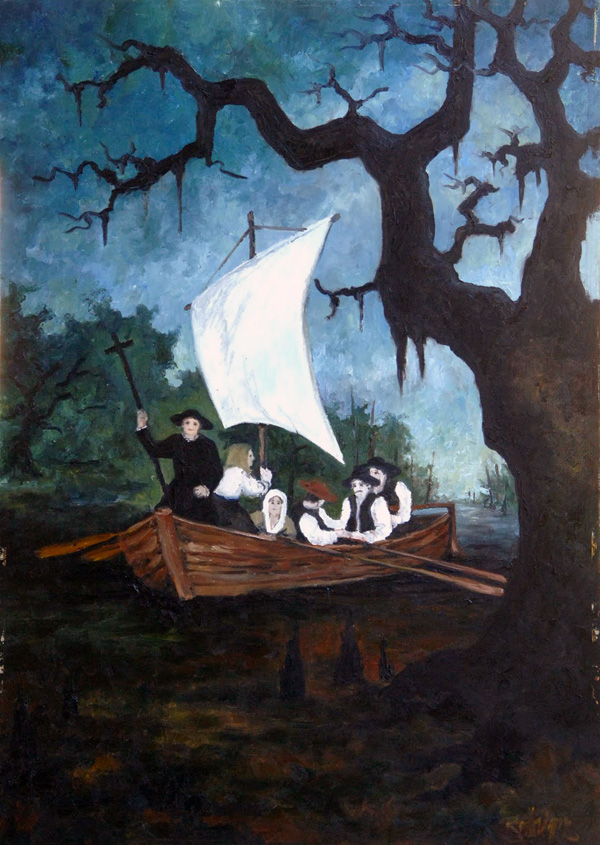
The book actually begins the Acadian story in the 17th century after a succession of five kings and a religious war that spanned the course of about fifty years. As France jockeyed for control of European lands in the 1600’s, it also sought dominance in the New World. It was in hot competition with England, even as the nation was fraught with civil and financial turmoil.
During the exploration of the New World, France and England fought bitterly for the rights to the land we know as Canada today. France had five colonies in New France as early as 1535, including Newfoundland, Louisiana, Hudson’s Bay, Canada, and Acadia. The French arrived in 1604 in the Bay of Fundy with the first charter for “the country of Acadia, Canada and other lands of New France” (p. 21). These frenchmen established a settlement near an indigenous people called the Mi’kmaq. Within three years, most of them had abandoned this Port Royal, except for a small group committed to the task of turning it into a viable, agricultural colony. By 1624, Port Royal’s champions and chief dreamers either had died or had suffered from lackadaisical interest in French immigration and/or external attacks from the English. During this hiatus in French colonialism in Acadia, the English gained a foothold in Port Royal over the decade spanning 1621-1632 and called their territory Nova Scotia, marking the beginning of French-English territorial disputes. England temporarily relinquished control of Acadia to France through the Treaty of Saint-Germain-en-Laye in 1632, and French leadership redoubled their efforts to entice Frenchmen to the fledgling colony. Here are some other important dates in Acadian timeline:
- 1636. The St. Jean arrived in Acadia, kicking off another wave of immigration.
- 1655. Conflict between the English and French resumed.
- 1670. The Treaty of Breda was signed.
- 1690. The English captured Port Royal.
- 1697. Treaty of Ryswick was signed, and Acadia was restored to France.
- 1704-1710. Acadians were besieged, and Port Royal was captured again!
- 1713. The Treaty of Utrecht ceded the island of Acadia to England. The Acadians vowed to remain neutral in the face of any future English-French conflicts.
- 1749. For the first time, English settlers arrived in Nova Scotia, displacing the Acadians.
As England continued to root themselves in their fledgling colony, the Acadians worked to keep the lands that they had developed and maintain their economic position by making good on their pledge to remain neutral politically. Unfortunately, this did not ensure their continued peace in their lands. In 1755, the British began expelling them from Acadia. Some Acadians were sent to their ancestral homeland of France, and many others were used to colonize other lands in a bid to strengthen whichever country promised the Acadians the best opportunity for survival. According to Hudson,
“…modern historians…put the pre-expulsion Acadian population at somewhere between 15,000 and 18,500. About 2,500 Acadians made it to Louisiana while several thousand eventually put down roots in Quebec, New Brunswick, Nova Scotia, or Prince Edward Island in Canada…perhaps half of those captured or driven off in the 1750s managed to reach the major Acadian settlements of North America. What happened to the rest? A horrifying number, of course, had died. Shipwreck, disease, and malnutrition claimed thousands of lives during the British campaign in Nova Scotia, and conditions in exile were hardly conducive to good health. But thousands more Acadians did survive and made choices…that landed them elsewhere” (p. 200).
Each chapter follows Acadians to lands in the diaspora: nine of the thirteen British colonies in North America (i.e., Massachusetts, New York, Pennsylvania, Connecticut, Virginia, Maryland, North Carolina, South Carolina, and Georgia); the Caribbean and South American colonies of Cayenne, Guiana, Saint Domingue, Mole St. Nicholas, and Kourou; Port Saint-Louis and Saint Malo in the Falkland Islands of Terra Australis; various French towns like Belle-Ile-en-Mer, Poitou, and Nantes; and Spanish Louisiana.
Hudson outlines the external forces shaping Acadians’ decisions to migrate or settle, including the need to develop colonial lands, to work depopulated lands in Europe, to provide an example of hard work and diligence to those deemed useless to empire, and to install people loyal to the crown. He states,
“Acadian exiles had been pulled toward the classical past by Bougainville’s obsession with terra australis incognito and the old regime’s demographic insecurity. They had been pushed forward into an ultramodern future of free white labor in the Caribbean and productive colonies dotting the French countryside. Acadians witnessed the rise and fall of a new imperial era, all as their own lives flowed inexorably away…When refugees such as White did look to the past, it was a garbled mess. So they rebuilt in the ever-changing present, using the materials at hand” (p. 211).
Indeed, the Acadians were a valuable commodity to imperialist powers. Not only did they possess the tenacity and ingenuity to make something out of nothing (e.g., they were renowned for transforming marshlands using abointeaus and related technologies), but they were adventuresome, reproductively fertile, and willing to take risks for the benefit of their individual families and their communities. Hudson portrays Acadian communities as close-knit, insular, and ethnocentric but also shrewd, opportunistic, and assimilating. Ultimately, he says, “That Acadians reversed the effects of the grand dérangement and lived together again was indeed a triumph – although one tinged with coercion and pain” (212).
I appreciated Hudson’s book as an overview of the Acadians’s history in the context of France’s and Britain’s imperialistic endeavors. I had heard of the African Diaspora but had not understood Acadian history as one of dispersion. Hudson exposed me to a lot of history that I had not studied (at least not in decades), and he sensitized me to an experience that is common to many downtrodden groups. Hudson’s book is well-researched and driven by the facts and details he has investigated. The names of leaders, places, and agreements are necessary and critical to understanding the Acadian plight, but they make the book feel very dense and muddled without textual structures to organize and enable the reader to keep track of the material presented. Additionally, using Deuteronomy 28 as a thread throughout the book left me wondering which sin(s) the Acadians had committed and whether they had experienced any blessings for their subsequent repentance. Overall, this was an interesting book and a good way to get introduced to the Acadian experience. It probably would be helpful to explore accounts written by other historians, as recommended by Timothy Hebert:
- Carl A. Brasseaux, Scattered to the Wind: Dispersal and Wanderings of the Acadians, 1755-1809, Lafayette, Louisiana: University of Southwest Louisiana Center for Louisiana Studies, 1991.
- Carl A. Brasseaux. The Founding of New Acadia: the beginnings of Acadian life in Louisiana, 1765-1803. Baton Rouge: Louisiana State University Press, 1987
- James Dorman. The People Called Cajuns: An Introduction to an Ethnohistory. Lafayette, Louisiana: University of Southwest Louisiana Center for Louisiana Studies, 1983.
- Donald J. Hebert. Acadians in Exile. Cecilia: Hebert Publications, 1980.
- Janet Jehn. Acadian Exiles in the Colonies. Covington, Kentucky: Janet Jehn, 1978.
Let me know what you think about any books you have read about the Acadian diaspora. Now, I hope to get deeper into my own family’s story and to share my findings with you!
 The Genealogy Griot