Many of you know that when you use certain online databases, you are given hints about other records that feature your ancestor or research subject. I’m embarrassed to say that I generally ignored the city directory hints in favor of, say, census or military records. Now, using a city’s directory as a resource seems like a no brainer. City directories are a wonderful tool. They offer a wealth of information, not just about your ancestor, but about the neighbors and the city or town in which they live. In this post, I use the Houston directory as an example of the general purposes of city directories and how you can use them in your genealogy research.
CITY OF HOUSTON DIRECTORY
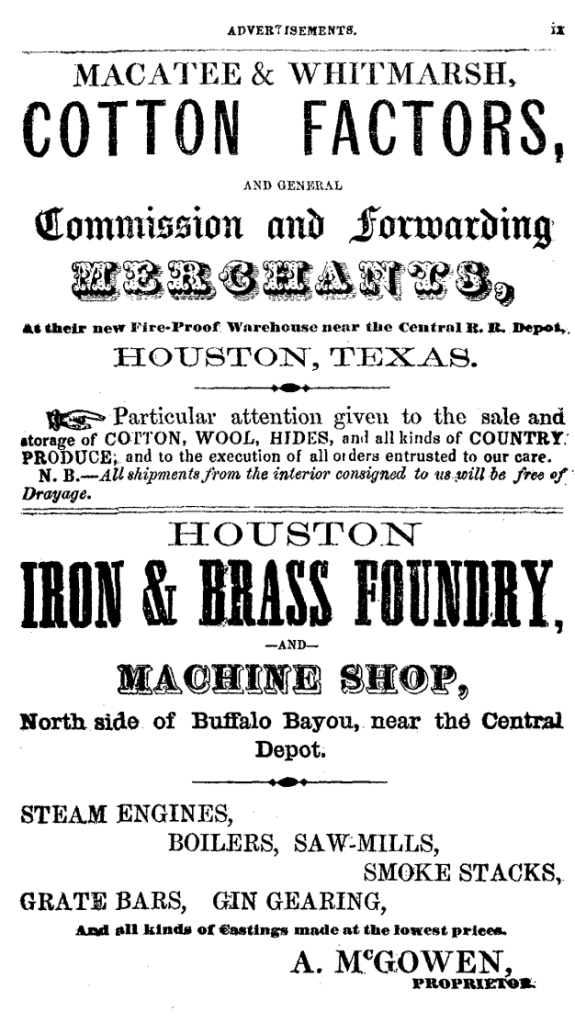
When I was researching my uncle’s family, I learned that the City of Houston published its first directory in 1866. Having begun his work in November 1865, shortly after the Civil War had ended, W. A. Leonard compiled the first directory. It was printed under the title, Houston city directory for 1866 : with a map of the city, directory to streets and localities, names of city, county, and state officers, provisions of city charter, compendium of ordinances, courts, post office, railroads, steamboats, churches, societies, an almanac for 1866, together with an appendix, containing the names of the city officers from 1838 to 1866, historical and statistical sketches of Houston, and articles on topics of local interest.[1] You get the idea that there is a lot packed into this directory! Primarily catering to the needs of the businessmen to whom his proposal for the directory was issued and whose subscriptions and advertisements funded the endeavor, Leonard intended to publish a directory by April 1 of each year. This directory would contain reference material as well as articles from interested and knowledgeable citizens. It was to be a handbook fulfilling multiple purposes, including listing the city’s streets and residents (with maps); providing a guide to the “localities and institutions” of the city; recording government entities, officials, and laws; and offering historical and statistical accounts of the city’s industries and other activities.
PURPOSES OF A CITY DIRECTORY
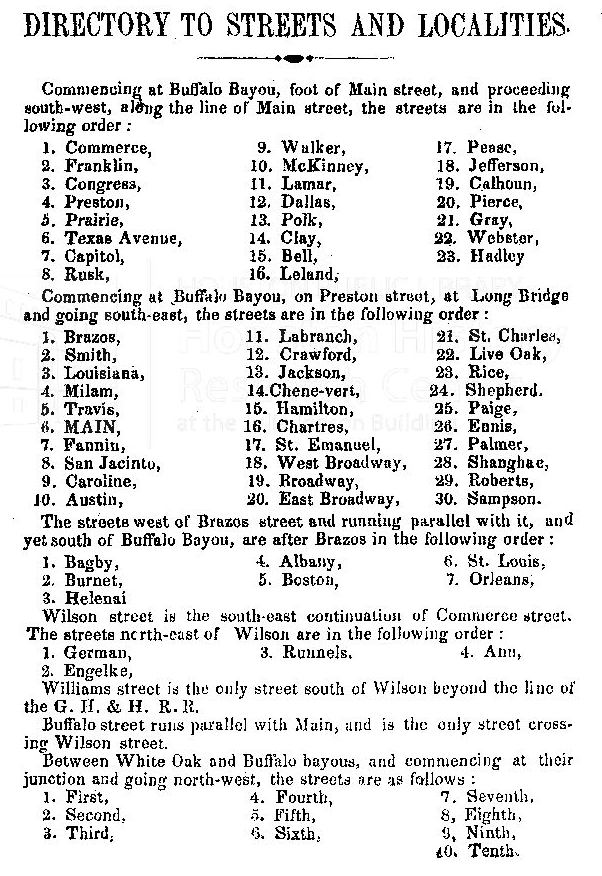
Like all directories, the publishers purported to list all of the city’s streets and residents. Preceding these sections was an abbreviation key. In terms of the streets of Houston, Leonard catalogued the major sectors or divisions and the streets within them. In its descriptions, natural landmarks, like White Oak and Buffalo Bayous, often were used as reference points. In earlier directories, addresses were referenced with streets only, whereas in later directories, numbered addresses were listed.
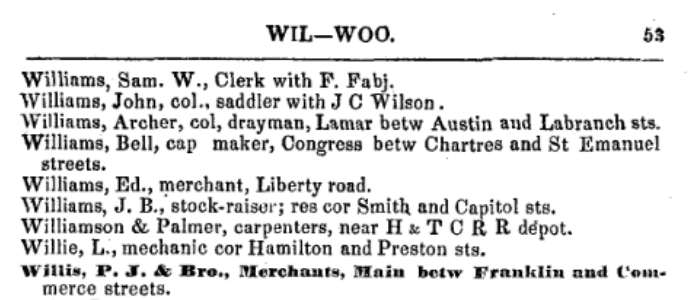
Regardless of race or sex, all heads of household who were available at the time of canvassing were listed, along with the address of their residence and, later, an indication of whether they owned, rented, or boarded at the property. African-Americans were indicated by “c” or “col”. Residents’ occupations also were referenced, as were their employers, in some cases. In some of the later directories, there is also an indication of the number of other household members or the name of the person owning the house where they boarded. Estates of deceased residents often were documented for many years after the death of the person, if applicable.
Directory publishers also provided a list of certain districts and institutions and a record of government infrastructure. The districts and institutions referenced included various businesses as well as organizations like churches and their cemeteries, fraternal orders, schools, post offices, courthouses, railways and steamboats, and markets. Days and times of operations, as well as the names of their officers were noted. In terms of the governmental infrastructure, the publishers thought it prudent to inform citizens about the general work of all levels of government. City officials, charter terms, and ordinances were published, along with information about state and county taxes, post office policies, and court calendars for all counties in the state.
Finally, there is usually historical information included, at least, in early city directories. It seemed that the intention was to stir up pride and patriotism in Houston’s inhabitants and to garner the esteem of its visitors. In the appendix of Houston’s first directory, the compiler included an overview of the history of area churches, educational institutions, and business affairs. Railroad development was of particular interest, and extensive information about crops was also described. The 1866 directory even had an almanac.
HOW A CITY DIRECTORY CAN HELP YOU
There are numerous reasons to use a city directory to conduct or enhance your genealogy research. Here are my top five:
- To get a real-time and insider perspective of the history, commerce, agriculture, social structure, and political organization of the city in which your ancestor or research subject lived and worked. Census publications (e.g., compendia, reports, and abstracts) provide statistics about life in states, counties, and cities during and a few times between census years; some historical sketches also provide such information. However, there are specific and unique details about these aspects of community that may be found only in city directories.
- To fill in gaps in your ancestor’s timeline, particularly if they cannot be found in certain census records. For example, since most population schedules pertaining to the 1890 U.S. Census were burned in a 1921 fire occurring in the Commerce Department building in Washington, D.C., there is a gap in federal data for many Americans that spans 1880-1900. That’s twenty years of life, death, and migration that you won’t know anything about it, unless you get creative. Looking for your people in the city directory might give you the information you need. Be sure to look year by year and page by page, in addition to using indexing tools.
- To get an idea of your relative’s residential and occupational patterns. Where did they live between censuses…were they relatively stable, or did they move around a lot? Who resided with them, or, alternatively, with whom did they reside? What was their work, and where did they work? How often did they change jobs and employers?
- To round out your knowledge about extended relatives. If you find unfamiliar people with surnames similar to those of your research subjects, you then may consult the census and other records to make connections between those people. If a city directory indicates that there are multiple people in the household, you can use vital and census records to get information about the complete household. Conversely, there may be people enumerated in census records who do not appear in the city directory when you would expect to find them. That conflicting information may lead to a research question you need to pose and answer.
- To answer questions about specific communities and their activities. For example, if I wanted to understand better how the Jewish community in Houston developed, searching early city directories for Jewish residents and/or their institutions may help me accomplish that.
I hope you found this post to be helpful in explaining the structure and utility of city directories in genealogy research. Please let me know in the comments have used or will use city directories in your own research.
[1] W.A. Leonard, compiler, Houston city directory for 1866 (Baltimore: Gray, Strickland, and Co., 1866), viewed on Houston Public Library Digital Archives (https://cdm17006.contentdm.oclc.org/digital/collection/citydir/id/15734/rec/2 : 10 December 2024).
 The Genealogy Griot