Do you know anything about President’s Day beyond that it’s a federal holiday? This year, I was inspired to research the subject by my oldest son, who recently decided to submit an article Martin Luther King, Jr. to his school’s newspaper to inform his schoolmates about why the federal holiday exists. In view of this year’s President’s Day, I am reviewing its history and having a little fun, too, as I poke around for any connections I may have to any of our 45 commanders-in-chief.
History of President’s Day
The holiday that is officially called Washington’s Birthday has its origins in the recognition of the contributions of George Washington, the United States of America’s first president. I found a reference to the significance of his life’s works to the nation in a newspaper, just one year before his death on December 14, 1799. The author wrote,
“With the greatest pleasure we observe that active preparations are making, in almost every town in the United States, for the celebration of the birth-day of the illustrious Washington, on the 22nd inst. when he enters on the 67th year of his life – a life ever devoted to the dearest interests and felicity of mankind. The enthusiastic happiness which pervades the breath of every patriot, the sincere gratitude and admiration that arise from. a contemplation of the services rendered the world in general, and America in particular, by George Washington, are such as men only can feel, but not sufficiently express.”1
Apparently, it was a common and regular practice to acknowledge George Washington’s Birthday. Celebrations usually were observed on February 22nd, Washington’s adjusted birthdate.2 It seems that citizens organized parades, singing, and food. Some towns sponsored lectures emphasizing patriotism and minstrel shows depicting George Washington’s military exploits with interludes that highlighted his slave ownership.3 I do not recall every having done anything special on President’s Day in my childhood, and, as an adult, it is simply a day off from work activities. After decades of celebrations – whether informal or statutory, city- or state-wide – Washington’s birthday was officially designated as a holiday for federal offices located in Washington, D.C., beginning in 1879. In 1885, the holiday was extended to federal offices outside of D.C.4
Resolved by the Senate and House of Representatives of the United States of America in Congress assembled, That the employees of the Navy Yard, government Printing Office, Bureau of Printing and Engraving, and all other per diem employees of the Government on duty at Washington, or elsewhere in the United States, shall be allowed the following holidays, wit: The first day of January, the twenty-second day of February, the fourth day o f July, the twenty-fifth day of December, and such days as may be designated by the President as days for national thanksgiving, and shall receive the same pay as on other days.
The Uniform Monday Holiday Act enacted in 1971 changed the federal observance of Washington’s Birthday to the third Monday of February.5
Among the states, the day is sometimes officially called President’s Day in honor of a variety of other presidents, most commonly Abraham Lincoln. My favorite states, Texas and Louisiana, officially recognize Presidents’ Day and Washington’s Birthday, respectively. Other states celebrate the presidents who were born within their boundaries; for example, Alabama recognizes Thomas Jefferson, in addition to Washington and Lincoln. While many states recognize President Washington and others on the third Monday in February, others observe the holiday on dates other than the federal date. In fact, Indiana and Georgia observe Washington’s birthday around the Christmas holiday!
Personal presidential connections?
So, here comes the fun part. Besides the general patriotism inspired by our federal holidays, I wondered if I could find more personal meaning in President’s Day. That is, do I have a direct or indirect connection to any of our presidents? I already know of one loose connection to George Washington. I am a descendant of Joel D. Shrewsbury, grandson of the salt mine titans of Kanawha Valley in West Virginia.6 His sister, Martha, married Dr. Lawrence Augustine Washington, Jr., the nephew of President Washington.7 I have found other presidential connections, too.
Relative Finder is a pretty cool tool that relies on documentary evidence as presented in self-reported family trees. This tool is a fun way to determine if you could be related to a historical figure whose genealogy has been well researched and documented. I say “could” because the accuracy of the relationship depends on the veracity and accuracy of the family trees used to calculate the degree of the relationship. To use Relative Finder, you must have a FamilySearch account with a family tree – the more built out and robust it is, the better. Once you log in to Relative Finder with your FamilySearch account credentials, your tree will be reviewed and analyzed for correspondence with the documented genealogies of FamilySearch’s database of various individuals in groups like Constitution Signers, famous Authors and Poets, Astronauts, and Sports Figures. Check out this video to learn how to use RelativeFinder.
Using the tree that I have input on FamilySearch, I discovered that 28 of our 45 presidents could be my cousins! Moreover, twenty-five First Ladies, including Anna Eleanor Roosevelt, could be my cousins. George Herbert Walker Bush appears on the list twice because we could be related through both his maternal and paternal lines.
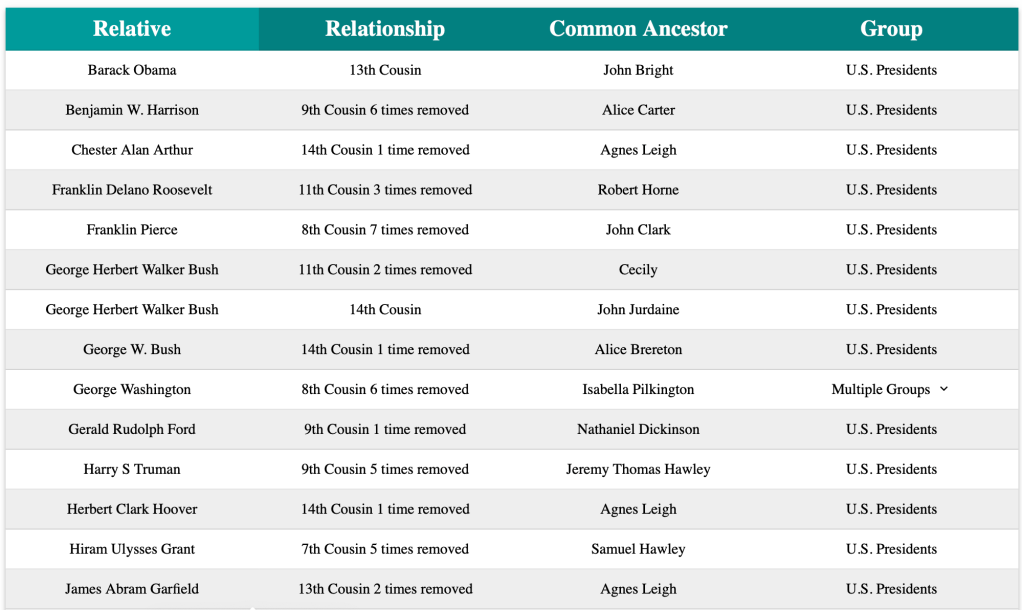
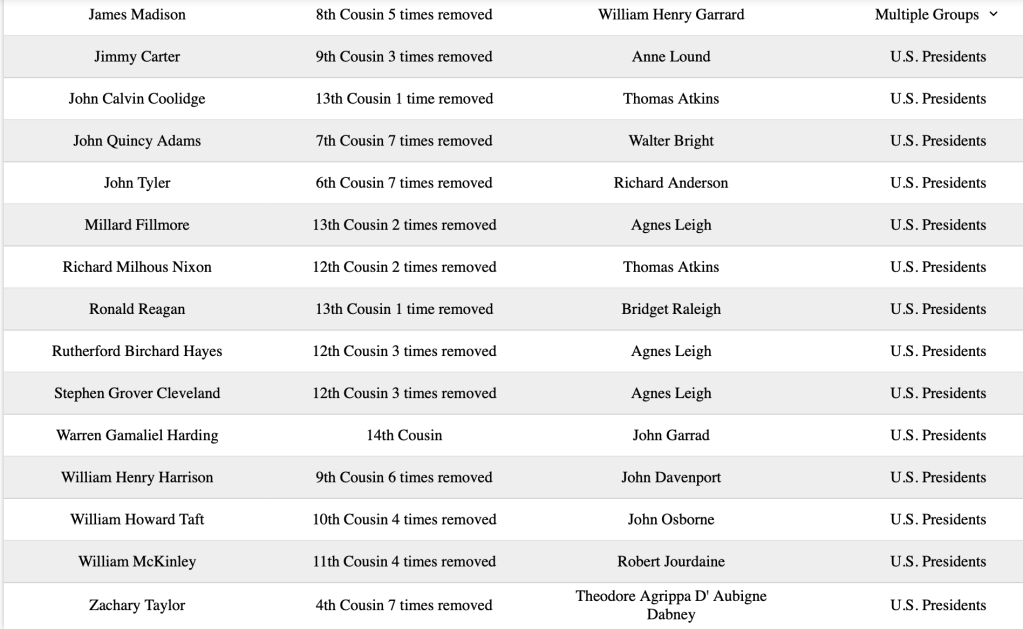
So, I decided to observe this President’s Day, not only by taking a break from school and work, but also by investigating whether I could be related to any of the men who have served as the chief executive of our nation. And, the answer is “Yes”. Given that it is one of the holidays that originally were intended to be viewed as days for national thanksgiving, I also will use this day to reflect on the blessings God has given me as it pertains to the leaders who have impacted my life. Let me know if you decide to use RelativeFinder and what you discover.
1 The New Hampshire gazette. [volume] (Portsmouth [N.H.]), 21 Feb. 1798. Chronicling America: Historic American Newspapers. Lib. of Congress. <https://chroniclingamerica.loc.gov/lccn/sn83025588/1798-02-21/ed-1/seq-3/>
2 “George Washington’s Birthday” The Center for Legislative Archives, (https://www.archives.gov/legislative/features/washington).
3 https://historycambridge.org/articles/celebrations-of-washingtons-birthday-reflect-tangled-legacies-of-immigration-integration/. The Lexington advertiser. (Lexington, MS), Feb. 16 1939. https://www.loc.gov/item/sn84024271/1939-02-16/ed-1/.
4 Act of January 6, 1885, No. 5, 23 Stat 516 (1885).
5 An Act to provide for uniform annual observances of certain legal public holidays on Mondays, and for other purposes, Pub. L. 90–363, 82 Stat. 250, enacted June 28, 1968.
6 “Mortuary: Mrs. Martha D. Washington,” The Galveston Daily News (Galveston, Texas), 01 Aug 1891 p, 3, col. 3; digital image, Newspapers.com (https://www.newspapers.com/image/63759640/).
7 Stealey, John Edmund. “Virginia’s Mercantile-Manufacturing Frontier: Dickinson & Shrewsbury and the Great Kanawha Salt Industry.” The Virginia Magazine of History and Biography 101, no. 4 (1993): 509–34. http://www.jstor.org/stable/4249394.
 The Genealogy Griot