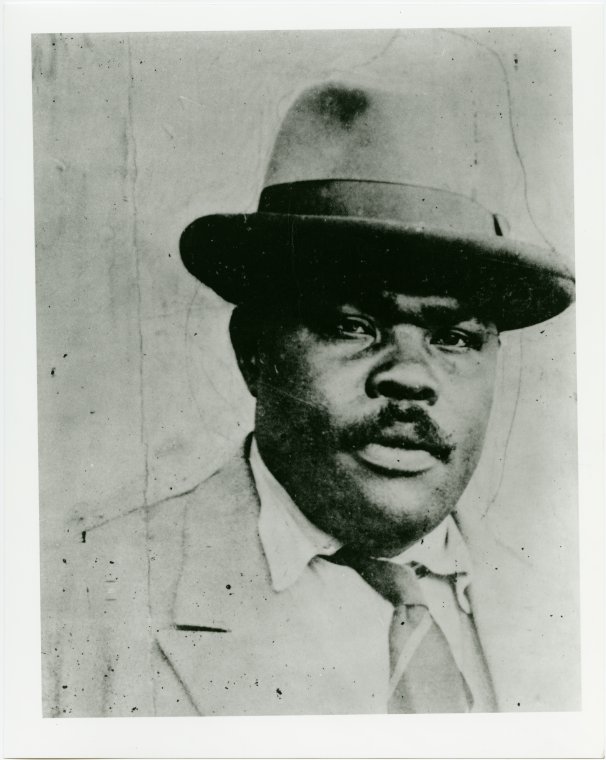
When former President of the United States of America Joe Biden pardoned Marcus Garvey, Jr. before vacating the White House on January 20, 2025, he awakened a 40 year-old childhood memory that I hadn’t entertained in a very long time. I wasn’t even 10 years old when I went with my dad to a party hosted by his sister friend, Valerie Michaud. Valerie spearheaded service projects in Haiti, and her gathering had something to do with her work and celebrating Marcus Garvey’s life accomplishments. I learned that night that Marcus Garvey was a charismatic and cogent leader who had advocated for the empowerment of Blacks of the African diaspora. I learned that he had formed the United Negro Improvement Association (UNIA) with aspirations of facilitating repatriation to Africa. After that night was over, all my interest in Marcus Garvey dissipated, and I was not compelled to learn anything more until now. I am planning to investigate his story and the background of his pardon more deeply, beginning with a review of seven types of genealogy resources I found in a quick internet search.
Death Certificates. Amy Ashwood Garvey died of lobar pneumonia on May 03, 1968, in Half Way Tree in St. Andrew Parish. The informant, Herbert Adams, reported that Amy was born in Portland [Parish] and was the “widow of Marcus Garvey, Politician”.1 About five years later in the same parish, another Amy Garvey died of pancreatic cancer. One Marcus Garvey was “qualified” to be the informant for this Amy Garvey’s record because he was her “son.” He reported that she was born in Kingston and was the widow of “Marcus Garvey, “politician”.2 Garvey had died on June 10, 1940, in London, England, after he “erroneously [was] reported dead” the previous month.3
Birth Certificates. The informant for the latter Amy Garvey’s death record was likely the Marcus who was born on September 27, 1930. Journalist Marcus Moziah Garvey affirmed that he was the younger Marcus’ father; Amy Garvey, nee Jacques, was his mother. At the time of young Marcus’ birth, the family lived on Lady Musgrave Road in a neighborhood called Half Way District in Kingston, St. Andrew Parish.4
Legal Indictment. Marcus Garvey was accused of criminal acts more than once. In 1924, for example, he was indicted for false and fraudulent income tax return and perjury, in violation of Section 253 of the Revenue Act of 1918 and Title II of the Act of February 24, 1919.5 However, a newspaper article reveals that this indictment was filed after he already had been convicted in 1923 “for using the mails [i.e., the United States Postal Service] to defraud in connection with his ‘back-to-Africa’ Negro colonization project” and his shipping business, the Black Star Line. He appealed the decision but lost that battle; Garvey began serving his sentence in 1925. He was released and deported in 1927, as a result of the commutation executed by President Calvin Coolidge.6
Marriage Announcement. It’s always nice to have an original record, but I didn’t find one in this search. I did, however, locate a newspaper article announcing that a marriage ceremony for Marcus Garvey and Amy E. Jacques was held on Thursday, August 03, 1922, at the home of the likely officiant, Rev. J.R. L.Diggs of Baltimore, Maryland. In attendance were Mrs. J.R.L. Diggs, Cora Earl, Mr. B.M. Johnson, and Captain Mulzack. At the time, Jacques was a resident of Kansas City, Missouri, while Garvey resided at 1205 Michigan Avenue, in New York City, where they “immediately” headed after the wedding. The reporter also mentioned that the “first Mrs. Garvey” divorced Marcus Garvey “last winter”.7
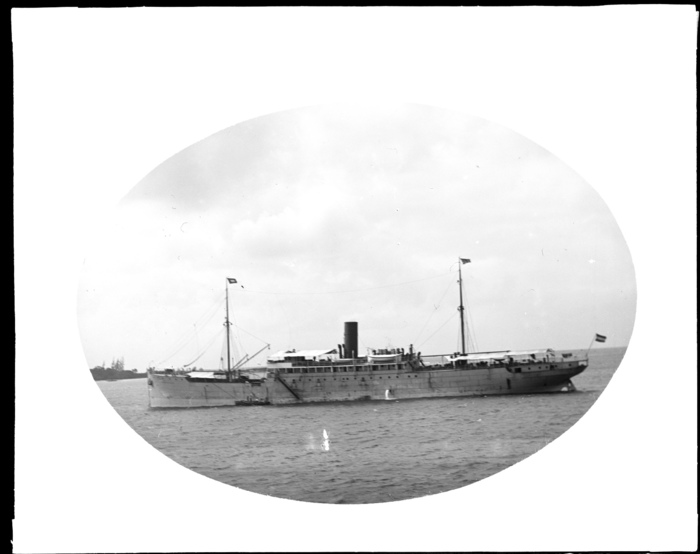
Passenger List. Listed on a 1921 passenger list for the SS Suriname, 33 year-old, 5’5″ Marcus Garvey sailed from Barrios, Guatemala, on July 09, and arrived in New Orleans, Louisiana, on July 12. His final destination was New York, the place of his permanent residence. He was accompanied by his secretary, Amy Jacques, and clerk Cleveland Jacques. In Jamaica, Garvey named W.E. Wilson as his closest associate and friend; Amy and Cleveland named their mother, Charlotte Jacques as their next of kin. This group of travelers and the acquaintances they listed were all nationals of British West Indies. Garvey was born in St. Anne Bay, Jamaica. While Garvey had previously been in the U.S. earlier that year, his companions had not been in the United States since 1918. Their associates in New York included Ida Jacques, the sister of Amy and Cleveland, and Indiana Peart, Garvey’s sister. Garvey reported that he was married, but his wife was not traveling with him at the time.8
1920 Census. Marcus Garvey appeared in the 1920 census as a 41 year-old who had immigrated to the United States in 1914. He was enumerated as a resident of Manhattan Assembly District 21 in New York City and headed a household that include his then wife, 24 year-old wife Amy. This is not the Amy mentioned in the previous three sections. No, this Amy presumably was his first wife, the one who would divorce him in 1921, the one who died in 1968 – Amy Ashwood Garvey. Curiously, we see his future second wife and secretary, 26 year-old Amy Jacques, lodging with the couple, along with 32 year-old Claudius Ashwood, and Alonzo Roberts. All household members were born in the West Indies.9
World War I Draft Registration Card. On June 05, 1917, Marcus Garvey registered for the World War I Draft as an “alien” who was born in Jamaica, West Indies, on August 17, 1887. He worked as a journalist for the “Universal Negro Association” in Jamaica. He was single and listed his father as his next of kin and dependent. Garvey claimed as his reason for exemption from the draft that he was “phisically [sic] unfit” even though no disability was documented by the person registering him. At the time, he lived at 235 W. 131 in New York City. He stood at 5’4″, and he was of medium build.10
Summary
In my cursory internet search, I found genealogical resources – death, birth, legal, marriage, immigration, census, and military records – that give me a few details about Marcus Moziah Garvey, Jr.’s life. From reviewing these documents, we learn that he was reputed to have been born in Jamaica, specifically, St. Anne Parish, in 1887. He had at least one sister, Indiana Peart, and his father reportedly was alive as of 1917. Garvey immigrated to the United States in 1914 and regarded himself as a permanent resident, chiefly settling in New York City. However, he was accustomed to traveling and had visited Guatemala at least once during his residence in the United States. Garvey was married at least twice, first to Amy Ashwood, sometime between 1917-1921, and lastly to Amy Jacques, his former secretary, in 1922. Through his marriages, he was acquainted with Ashwood’s likely relative, Claudius, and Jacques’ brother, Cleveland, sister Ida, and mother, Charlotte. Garvey worked as a journalist, ship owner, and politician, ultimately leading a movement under the banner of his Universal Negro Improvement Association. He championed a return of the descendants of African slaves in British and American colonies and states to Africa, and it was this endeavor that led to his conviction in 1923 and imprisonment in 1925. Garvey’s sentence was commuted in 1927, and he was deported to Jamaica, where his son Marcus III was born in 1930. His two wives died in the same general area in Jamaica in 1968 and 1973.
To further my knowledge about Garvey and to contextualize the information I have found thus far, I would tap into the resources that are available in the regions in which he lived and worked (I know that he also spent time in England, Canada, and several countries in Latin America). Keying in on vital records, directories, ship passenger lists, maps, passports, and visas, I would gather birth, death, marriage, divorce, and residential data related to Marcus Garvey, his family of origin, and his wives. I would like to know more about Garvey’s parents and other influences as well as when and where he married his two Amys and the nature of their relationships with one another. Collecting newspaper articles about his work, social engagements, and prosecution and reading Garvey’s own writings would give me information about his activities and travels as well as provide insight about his vision for the people of the African diaspora. I would also search court records, FBI files, and other resources to understand the events and circumstances that led to his conviction and commutation, and to examine the alleged, concerted and systemic efforts by the federal government to undermine, discredit, incriminate Marcus Garvey and his movement.
President Biden’s pardon of Marcus Garvey was momentous, and I’m glad that the Garvey family could experience some kind of closure and satisfaction from decades of work to get him exonerated. It led me to uncover and enjoy reveling in a memory that involved my dad and his commitment to teaching us the history of black people. The pardon also spurred me to learn more about Marcus Garvey…Currently, I am reading Marcus Garvey and the Vision of Africa by John Henrik Clarke, and I hope to post my thoughts on it sooner than later. Thanks for reading!
References
1 “Jamaica, Civil Registration, 1878-2000,” FamilySearch (https://www.familysearch.org/ark:/61903/1:1:QK9S-P5XN : accessed 13 March 2025), Entry for Amy Ashwood Garvey, 03 May 1969.
2 “Jamaica, Civil Registration, 1878-2000,” FamilySearch (https://www.familysearch.org/ark:/61903/1:1:Q24B-ZDD7 : accessed 13 March 2025), Entry for Amy Garvey, 25 Jul 1973.
3 “Marcus Garvey Died in London,” The Guardian (Boston, Mass.), 15 June 1940, p.1, col. 4; digital image, Chronicling America: Historic American Newspapers (https://chroniclingamerica.loc.gov/lccn/sn83045863/1940-06-15/ed-1/seq-1/).
4 “Jamaica, Civil Registration, 1878-2000”; digital image, FamilySearch (https://www.familysearch.org/ark:/61903/1:1:XNDJ-PPT : 13 March 2025), Entry for Marcus Garvey, 17 Sep 1930.
5 United States of America v. Marcus Garvey, 8/4/1924 – 6/9/1932; Records of District Courts of the United States, Record Group 21. [Online Version, https://www.docsteach.org/documents/document/united-states-of-america-v-marcus-garvey, March 2, 2025]
6 “M. Garvey Released: Famous Leader to be Sent to Jamaica– The End of Long Struggle for Freedom,” Richmond Planet (Richmond, Va.), 26 Nov. 1927, p.1, col. 1; digital image, Chronicling America: Historic American Newspapers (https://chroniclingamerica.loc.gov/lccn/sn84025841/1927-11-26/ed-1/seq-1/ : accessed 13 March 2025).
7 “Marcus Garvey Marries in Baltimore,” The Appeal (St. Paul Minnesota), 05 August 1922, p, 2, col. 5; digital image, Newspapers.com (https://www.newspapers.com/image/78628872 : accessed 13 March 2025).
8 “List or Manifest of Alien Passengers for the United States Immigration Officer at Port of Arrival”; digital image, p. 500 of 716, Ancestry (https://www.ancestry.com/search/collections/7484/records/937961 : accessed 13 March 2025); citing NARA Passenger Lists of Vessels Arriving At New Orleans, Louisiana, 1903-1945, Record Group Number 85.
9 1920 U.S. Census, Manhattan Assembly District 21, New York, population schedule, New York, enumeration district 1409, p. 15B, family CDE, Marcus Garvey household; digital image, “1920 United States Federal Census,” Ancestry (https://www.ancestry.com/search/collections/6061/records/110558563 : accessed 13 March 2025); citing NARA microfilm publication T625_1223.
10 “U.S., World War I Draft Cards, 1917-1918,” card for Marcus Garvey, 05 June 1917, serial no. 157, Draft Board 139, New York City, New York; digital image, Ancestry (https://www.ancestry.com/search/collections/6482/records/14882537 : accessed 13 March 2025).
 The Genealogy Griot