(All quotes are cited from pages linked from the AncestryDNA Regions and Journeys FAQ page)
AncestryDNA recently made an update to its algorithm for determining ethnicity estimates. According to its website, AncestryDNA “calculates your ancestral regions by comparing your DNA to a reference panel made up of DNA samples from more than 185,000 people representing 146 different populations.” Prior to this update, the reference panel consisted of 107 populations. As the company acquires more DNA samples to add to its reference panel, the company gets more information about peoples and their associated geographical locations. Moreover, the company “change[s] [its] analysis techniques”, perhaps using additional strategies, enhancing others, or diversifying their approaches. So, what should we do with the DNA reports we receive from AncestryDNA and other companies like it? I have a few suggestions.
Actually examine your DNA summary and related pages, reports, and videos
This recommendation may seem like a no-brainer, but, if you are anything like me, you might feel a bit overwhelmed or tend to focus only on your initial screen without doing much else. I encourage you to dig deeper and explore all of the information presented. This would include, not only the standard DNA Summary, but also the “Ancestral Regions” and “Ancestral Journeys” pages. If you click on the “Origins” tab, you can explore your estimates by looking at each parent or clicking on the color-coded map to learn more about the region, itself. The amount of information on your screen is dizzying, but it’s fun to wade through it if you can find the time. I have many family- and work-related obligations, so I definitely get it if you have time constraints. However, maybe you can squeeze in 15 minutes of genealogy research as you plan your daily schedule, even if you have to use your phone while on the go. If you have a little more flexibility, you might consider scheduling a whole day of your week or month to devote to researching the people to whom your DNA connect you.
When you finally get a chance to do a deep dive on the update, you will see your information organized according to “macro-regions”, which contain groups of specific regions “defined by geography or population”. This approach to organizing your data is not different than the approach used before this update, but the group labels are. The company’s goal is to make “results easier to scan and more relatable… [and] to enhance clarity, comprehension, and stability of results year-over-year”. I’m not sure that the update has achieved the goal of clarity and comprehension, though. I sent one of my relatives a snapshot of his update, and he didn’t even open it. When I tried to explain it, it seemed to go over his head. I probably flubbed the explanation, but maybe the rollout of the update was just too much.
AncestryDNA says that it came up with these estimates by comparing our DNA “to the DNA of people with long family histories from specific parts of the world…[that is,] a reference panel that includes people whose DNA is typical of DNA from a certain place. To do this, [they] look for people whose families have lived in the same country or part of a country for generations. These are customers with deep roots to that place, and their long family history in that place is reported in their Ancestry family trees”. I have to admit – I read this with some skepticism because the analysis is based on family trees, many of which are notoriously inaccurate. However, I assume that the company is verifying the trees of those individuals included in the reference panel, which is made up of some of the people who have tested with them as commercial customers as well as “people from past scientific studies”. We definitely should read related white papers (scientific reports that more fully explain the company’s approach to this whole process).
Compare your current data with data from previous updates.
I don’t know about you, but I could do better with organizing my research. I have not kept track of my DNA updates very diligently. Thankfully, however, I do have a few artifacts from the last 10 years…I found a screenshot of a side-by-side comparison of my DNA and my mom’s paternal aunt’s DNA; an image I shared on an old post about my DNA results; and a few .pdfs of past ethnicity updates.

The downloaded .pdfs represent data presented in September 2018, August 2019, and July 2024 updates. Prior to the 2018 update, AncestryDNA had only about 3,000 reference samples; you can see that the company added over 100,000 reference samples over the 6-year period covered by my updates. Note that, based on the changes in the reference panel, analyses, reporting, etc., my ethnicity estimates changed significantly. Around 2017, estimates for my Jewish and Iberian, Senegal, Ireland/Scotland/Wales ranged 3-5%; Great Britain represented 12% of my ethnicity. Nigeria was represented at that time but not in the 2018 estimate. It showed up in my 2019 estimate, but, in the 2024 estimate, decreased by 19% and yielded two splinter groups (Central Nigeria and North-Central Nigeria) that made up a total of 4% of my total estimate! Between the 2020 and 2024 estimates, England and Italy totally disappeared, while France increased back to its 2018 level; and Indigenous Americas-North made its debut. Hm. What a mess of ups and downs! It seems like pure confusion.
Comparing the 2024 update to the current one, my Nigeria estimate bounced back up by 4%, and Benin and Togo increased by 1%. Khoisan, Aka, and Mbuti Peoples comprise 1% of my ancestry. France was split and appears in my estimate as 9 % Acadia (macro category French Canada). My Cameroon, Yorubaland, Central West Africa, and North-Central Nigeria all decreased by 1-2%. In Europe, I saw gains in Denmark (1%), and new categories popped up for me – Northern Spain (2%), Northwestern Italy (2%), Southern Wales (split off from general Wales, 3%), Germans in Russia (1%), and Northwestern Germany (1%). The Netherlands decreased by 5%, and I was disappointed to find out about it while actually hanging out in Heijen and Amsterdam.
Compare your results to those of your close matches.
If you have any close relatives, you might want to compare your data to theirs in order to enhance your understanding of your ancestry. Why? Not to insult your intelligence, but let’s establish a baseline understanding for all of us. Here’s what AncestryDNA explains about close matches like parents and siblings, “While we each inherit 50% of our DNA from our father and 50% from our mother, that also means that there’s 50% of each parent’s DNA we don’t get. If your parent has only a small percentage of DNA for a specific region, you might not inherit any of that portion of their DNA.” Also, “Siblings also get 50% of each parent’s DNA, but which DNA segments they get is completely random, which is why your results won’t necessarily match your sib’s–unless you’re identical twins.” In addition to these truths about how genes work, keep in mind that, with the change in AncestryDNA’s analysis procedures, “…regions you previously inherited only small percentages for could now be below the level that [they] report in your results.” This means that, even though you do not see it represented in your ethnicity estimates, some of your ancestry may waiting in the wings to be acknowledged and invited to the party at a later time. You really need to look at the ancestry updates for your parents and siblings, if they already have tested.
AncestryDNA has a cool feature that enables you to compare your people side by side, offering you a more comprehensive view of your geographical origins and giving you an idea of which families might contribute to your ethnicity estimates. Since both of my parents are deceased and I don’t have any biological siblings, it has been super helpful for me to look at the data of my aunts and uncles who have taken the tests. I compared my data with the data of two of my mother’s sisters and two of her aunts, one maternal and one paternal (columns 3-6); I also compared my data with that of one of my dad’s paternal aunts and one of his paternal uncles (the last two columns, sorry about the blurriness!).
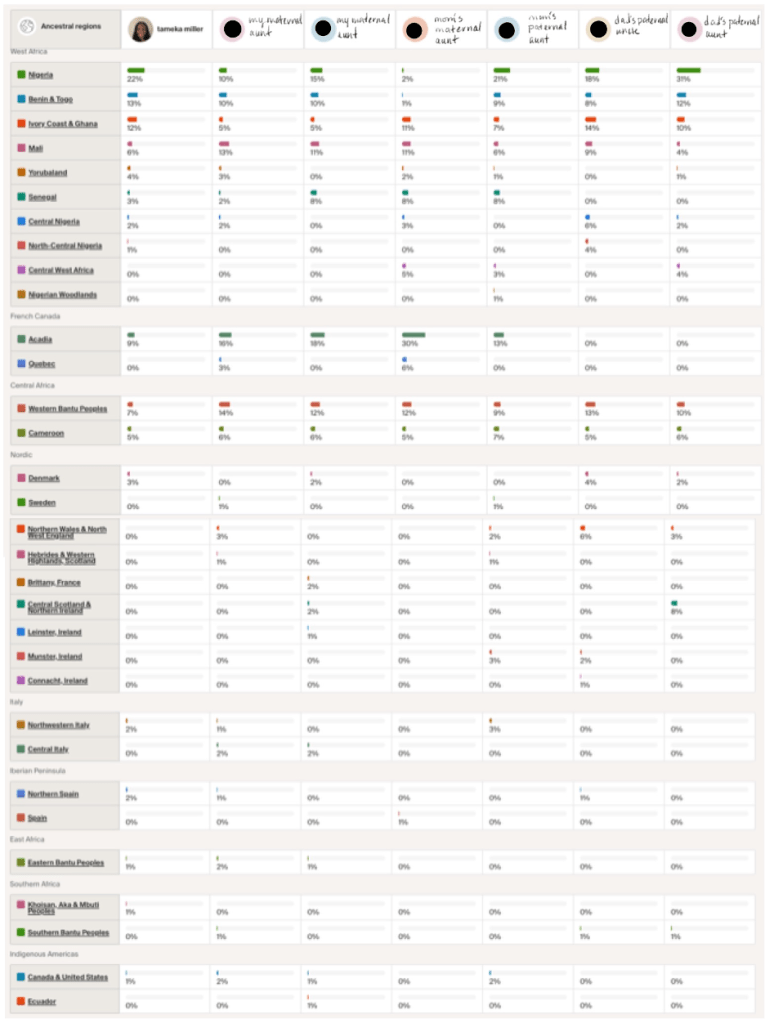
All of my aunts and uncle have ancestry associated with the regions Nigeria, Benin & Togo, Ivory Coast & Ghana, Mali, Cameroon, and Western Bantu Peoples. Their other regional estimates are more varied. In several instances, I have 0% apparent ancestry for regions that are, in fact, expressed in my aunts’ and uncle’s estimates. Their estimates in most of these regions are pretty low, themselves – 1-2% in the case of Central West Africa and Quebec, for example. However, they have a higher percentage of ancestry associated with regions like Northern Wales & North West England and Central Scotland & Northern Ireland, in which case the total estimates of my great-aunts and great-uncle account for 11% and 8% of their ancestry, respectively. Looking at my current estimates, you would never know I had English or Irish ancestry.
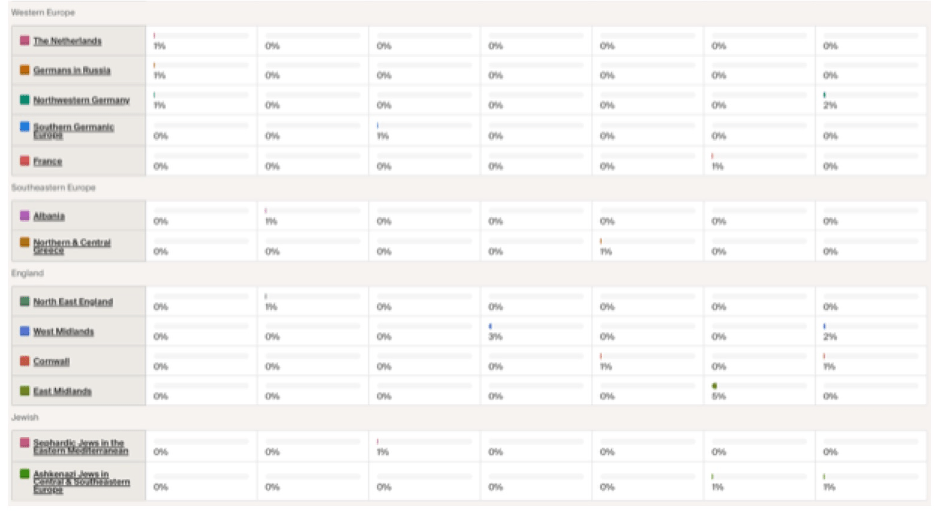
Keep your eye out for ancestors with the indicated origins
When we conduct genealogy research, we must determine on whom to focus our attention and which strategies to use in finding pertinent information about the subject. You can use your ancestral origins and journeys to guide you to fruitful lines of inquiry. For example, oral tradition and vital records indicate that my African-American ancestors identified themselves as descendants of the European-American, Shrewsbury family of Virginia. Those Shrewsbury’s are reputed to be of English descent. Perhaps, ethnicity estimates can be used to support (not prove) this assertion and/or lead me to alternatives that point to possible Welsh or Irish origin. Without the information I have about my ancestral origins, I might have hesitated to delve deeply into a person of Irish ancestry; now, I am more open to those possibilities.
Conclusion
The AncestryDNA update can be helpful in many ways if you actually read and explore the data, compare them with data from previous updates and the data of your close relatives, and allow them to inform your research strategies. The company’s updates are intended to offer more “precise” results that expand our knowledge and perhaps our understanding of who we are – our identities, self-perceptions, worldviews, and even values. Truthfully, I end up feeling the same way I do when Apple prompts me to install new iPhone software – annoyed. Nonetheless, I recognize that I can benefit from such updates because, then, I can update my research knowledge, skills, and abilities. I remain curious about what the future of DNA will bring to my ancestors’ stories.
 The Genealogy Griot